
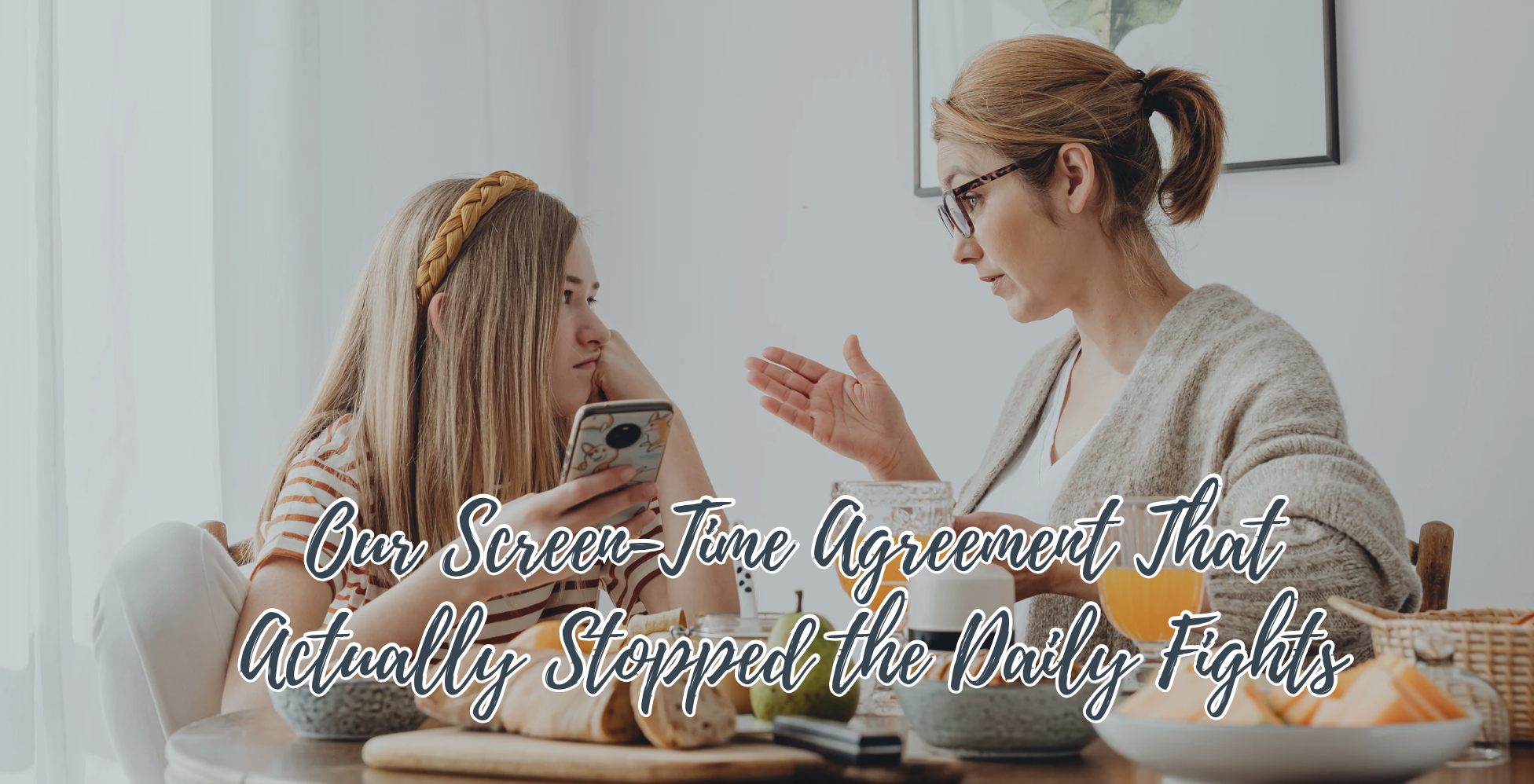
For almost two years, screen time was a daily battle in our house. Every evening started with “just five more minutes” that turned into forty. Every dinner had at least one phone-related standoff. I was exhausted, my kid was resentful, and nothing was actually changing.
Then I stopped trying to enforce rules — and started building an agreement instead. And everything shifted.
Today I’m sharing exactly how we did it, including the template we used, why it worked when everything else hadn’t, and what I’d tell you to do first.
Why “Just Set Rules” Never Works Long-Term
I tried the hard-line approach. I tried “phones off at 7pm.” I tried parental controls. I tried taking the phone entirely. And every single approach created one thing: an adversarial dynamic where my kid’s main motivation was to find workarounds.
The problem wasn’t the rules — it was that I made them unilaterally. My kid had no say, no context, no investment in the outcome. So why would they care about following them?
The shift happened when I stopped treating screen time as a discipline problem and started treating it as a systems problem. We didn’t need more enforcement. We needed a better structure — one my kid actually helped create.
How to Have the Conversation
The most important step is how you open this. Here’s what worked for me:
“I want to talk about screens — not to lecture you, but because I actually want your input. You’re old enough to help create rules that work for both of us. Can we sit down this weekend and figure it out together?”
This one sentence does something critical: it repositions you from enforcer to collaborator. When kids help create the agreement, they’re far more likely to honor it — because it’s theirs too.
The Agreement Template
Here’s the basic structure we used. Feel free to adapt it for your family:
Section 1: Phone-Free Times (Non-Negotiable)
These are the zones we agreed on together — times when phones go away for everyone, including me:
- During family meals
- The first 30 minutes after school (decompression time)
- After 9:30pm on school nights / 10:30pm on weekends
- During family activities when we’ve agreed to be present
Section 2: Daily Limits We Both Agreed On
We used the screen time tracker on the phone itself — not a third-party app, they resented those more — to set soft limits. The key: they chose the numbers. I just gave input on what felt reasonable.
Section 3: What Happens When It’s Not Working
This part matters more than people think. We agreed ahead of time on what the consequence would be if the agreement wasn’t honored — so it wasn’t a surprise or a punishment in the moment. That removes the power struggle entirely.
We put the agreement in writing — literally typed it up, both signed it, and put it on the fridge. Something about the physical document made it real. It went from “Mom’s rules” to “our agreement.” A completely different dynamic.
What to Do When They Break It
They will break it. That’s not failure — it’s normal. Here’s how to handle it without blowing the whole system:
“Hey — we have an agreement about this, and right now it’s not being honored. I’m not angry, but we do need to follow through on what we agreed. [Consequence]. We’ll try again tomorrow.”
Keep it calm. Keep it brief. Point to the agreement, not your feelings. This keeps it from becoming a power struggle and reinforces that the agreement is the authority — not just you.
How Long Did It Take to Work?
We had about a week of testing — where my kid pushed to see if the agreement was real or just another set of rules I’d eventually give up on. Once they realized I was going to follow through consistently, and that I was also following the agreement myself (phones away at dinner, no exceptions), it settled.
By week three, the daily arguments were gone. Not because I’d “won” — but because we’d built a shared structure we both respected.
That’s the whole point. You don’t want to win the screen time battle. You want to model the kind of self-regulation you’re trying to build in them.
Want the Full Screen-Time Template?
My Conversation Scripts Guide includes a complete screen-time agreement template plus scripts for the hardest conversations around phones and technology. Instant download, $17.
Get It Now →This blog post is part of ‘Blogaberry Dazzle’ hosted by Cindy D’Silva and Noor Anand Chawla.



That’s a really pro tip. Making your kids collaborators in the discipline, instead of going for enforcement. It really builds a good rapport and habit.
Your screen time agreement sounds so practical and refreshing. I love how you turned daily conflicts into something collaborative and calm. It’s such a great reminder that clear expectations can make a huge difference for both kids and parents.
Very important lesson for parents of this age. As children, parents made our rules for us and we simply followed them, unquestioningly. Not any more. We need children’s buy-in. And it does make sense, I believe, for today’s day and age. Sensible, mature approach, I’d say.
I love this! This is the only way to get kids to toe the line. I am totally for fixed screen time for kids. Screens are robbing kids of their childhood and making them the couch potatoes that we hate. But, yes, as you mention, no mobiles around the dining table applies to everyone.
Screen time is a struggle that all parents have to tackle with their kids. I liked your negotiating technique and glad that it worked too. It might work with younger kids but teenagers like mine are a lost cause!
This is brilliant. I’ve also noticed that when we impose unilaterally, it doesn’t work. Will try this and see how it works for us. Thanks for the suggestions and input.
Yeah we have the same struggle at home. my child does not have a phone yet but our argument is on tv time.
One of the biggest reasons for disagreements with kids. Five minutes to 40. I also have fixed rules and although those rules create a stir every now and then, they are here to stay.
Good one. Involve the children and there you can have rules that can be followed. I did that in classrooms too. Asked them when they can submit their homeworks and I never had to chase for the books