
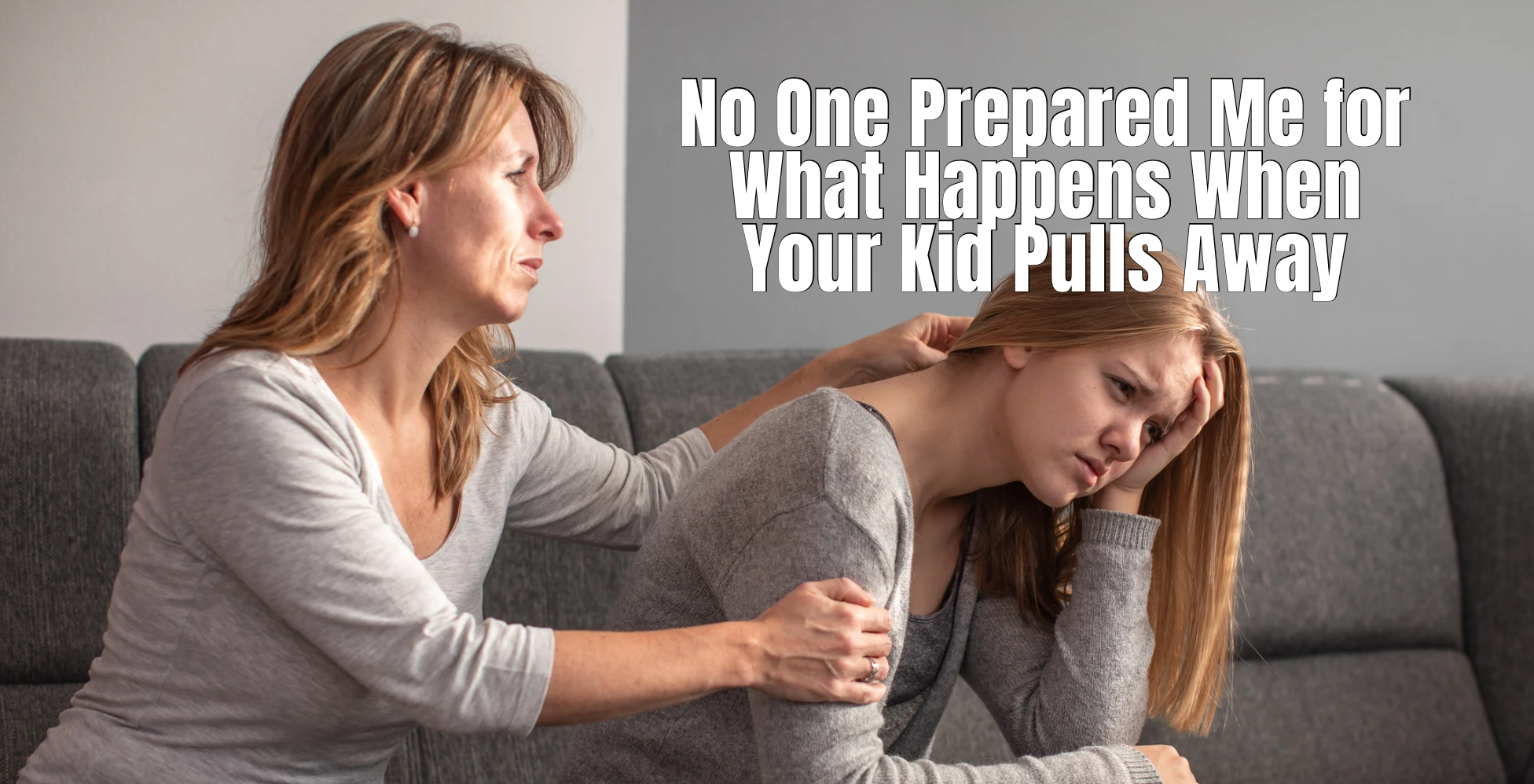
Nobody warned me that one of the hardest parts of having a tween wouldn’t be the attitude, or the eye rolls, or the “you don’t understand.” It would be the distance. The quiet withdrawal of a child who used to tell me everything. The moment I realized I wasn’t the first person they wanted to talk to anymore.
If that’s where you are — I want you to know you’re not alone, it’s not your fault, and there are things you can do about it. But first, I want to name something most parenting content skips over entirely:
This Is a Loss (And It’s Okay to Feel It)
When your child was small, you were their whole world. You were the first face they looked for in a crowd, the voice that calmed every fear, the person they ran to with every scraped knee and every joy. That role was profound. And when it starts to shift — when they pull away, when they start turning to friends instead of you, when they want privacy instead of closeness — it can feel like grief. Because it is, a little.
You’re not losing your child. But you are losing a version of your relationship. And it’s worth acknowledging that before we talk about what to do next.
What’s Actually Happening Developmentally
The pulling away isn’t random, and it isn’t a reflection of the relationship you’ve built. It’s developmental. Your tween or teen’s primary psychological task right now is individuation — the process of figuring out who they are as separate from you. That process requires some distance. It requires testing their own ideas, making their own choices, and forming an identity that isn’t just “your kid.”
The pulling away is, in its own strange way, a sign that you’ve done something right. Secure kids pull away. They explore. They come back. The problem only emerges when the pulling away breaks the connection entirely — when they stop coming back. That’s what we protect against.
The Three Mistakes That Make the Distance Permanent
In our desperation to stay close, most of us do things that accidentally push them further away. I made all three of these.
1. Chasing the Connection
When they pull back, we lean in — more questions, more check-ins, more attempts to recreate the closeness we used to have. To a tween or teen, this feels suffocating. The more we chase, the more they retreat.
2. Taking the Distance Personally
When their withdrawal makes us visibly hurt or anxious, we inadvertently make them responsible for our emotional state. Now they’re not just dealing with adolescence — they’re managing our feelings too. That’s too much weight. They pull back further.
3. Reacting to the Behavior Instead of the Need Underneath
The withdrawal, the closed doors, the one-word answers — these behaviors have needs underneath them. Usually the need for space, autonomy, or emotional safety. When we react to the behavior, we miss the need entirely.
What to Do Instead
Here’s the counterintuitive truth: the way to stay close is to give more space, not less. Not abandoned space — held space. There’s a difference.
“I’ve noticed you’ve needed more space lately, and I want you to know I respect that. I’m not going anywhere. When you want me, I’m here — no agenda, no lecture. Just me.”
Then back it up with action. Be around without hovering. Ask one question instead of five. Choose side-by-side activities over face-to-face ones. Let them lead the pace of reconnection.
When to Worry vs. When to Trust the Process
There’s normal teenage withdrawal — and then there’s something that needs attention. Here are the signs that what you’re seeing is typical development:
- They still come out for meals, family events, and occasional connection
- They’re engaged with friends and activities outside the home
- Their mood is generally okay even if conversations are brief
- They’ll accept help or comfort when they’re genuinely struggling
If instead you’re seeing persistent withdrawal from everything, significant mood changes, dropping grades, or loss of friendships — those are signals worth paying attention to and potentially worth getting professional support around.
I stopped trying to recreate the relationship we used to have, and started building the one that fits who they are now. The tween and teen years aren’t the end of closeness — they’re the beginning of a new kind. One built on mutual respect and genuine conversation rather than dependency. It’s different. And in so many ways, it’s even better.
A Note for You, Mama
This season is hard in a way that’s hard to explain to people who aren’t in it. You’re still so needed — just differently. The work you’re doing right now, staying warm when they’re cold, staying available when they’re distant, repairing when things break — all of it matters. All of it is building something that will outlast this stage.
Keep going. They see you more than you know.
You Don’t Have to Figure This Out Alone
Join the Mommy With A Goal community — weekly conversation scripts, honest parenting reframes, and a judgment-free space for moms in the tween and teen years.
Subscribe — It’s Free →This blog post is part of ‘Blogaberry Dazzle’ hosted by Cindy D’Silva and Noor Anand Chawla in collaboration with Sameeksha Reads.




It’s so difficult to become different people at different times, but I guess that’s adaptation. Mothers are so generous, I feel they work so much on relationships. Your post is so helpful for moms.
You have no idea how helpful this is for me. I am a mom of two and a tween mom. its been hard dealing with and figuring out her emotions
Hey Jeny dear… I am trying to wear a different face at different time to make sure i make all my roleplays at mommy as per time requirement. I love my child a lot, but 2 says before he fell on stairs and got deep cut below chin and blood was all over. I felt like crying loud but I didnt or that will make the child even weaker. I pull him up, put the cotton, called his papa and kept saying him nothing to worry doctor will see and all will get fixed not to cry. He was observing even in pain and when he saw the confidence on my face he hugged me tight and slept on my lap and we took him to hospital. That boy went alone in kids OT room with plastic surgeon and got the stitches done without creating tantrum and came out on doctor’s lap with a smile. I took him and said I am so so proud of him for his brave act and that put a bigger smile on his face and gave him the confidence he can do it. Next day he performed with full energy on stage on school annual day and his teachers where in shock when they got to know 5 stiches done and he still performed flawless. I am prepared for the withdrawl when he will be teenager as that’s the process. I am making him strong so that he can survive and stay confident whereever he go and parents cant be everywhere. If he needs us anytime a call is enough ti see us in front of him, but he should know how to stay confident without parents everytime… and in this process withdrawl is natural.
I am so glad you wrote about this. Posts like these will help Mom’s who are facing teh same predicament as you.
This is such an important developmental stage for children. I love the line where you say if there pulling away then it means we’ve done something right. Excellent advice you give throughout the post. Kudos.
I wish many moms with teens read this. It is a phase. It is not an easy phase, but parents have to know how to handle the. Whatever the situation, keep the communication open always. This is very critical for young tweens or teens.
This was such an honest piece. The idea that parents grieve the old version of their child really hit me. Growing up changes the relationship, but your words remind us the connection is still there- just different.
Parenting these days is becoming tougher day by day. hese are some points that can be utilized to deal with the situation.
Kids nowadays distance themselves much earlier than we did, thanks to their gadgets. I guess one needs to take it as a developmental milestone and accept it. Good to not fuss over them the entire time. More freedom for us.
I can only imagine the condtion when a perent starts noticing the increasing distance between child and parent as they grow up. Back of the mind everyone must be aware that one day, kids will have their own opinions, ambitions, dreams and will power, capacity and capability to fulfill them. And yet it kind of hurts when this actually becomes reality and next generation takes off from the nest to fly on their own.
I’m right there. As you’ve mentioned, it’s not easy, and I’m learning every day. Sometimes I’m angry; at times I’m relieved, so it’s a mixed bag. True, this is a phase every mother finds herself in, and it helps to be prepared and be ready for it.
This is such a helpful post. I’m still a couple of years away from this stage but will definitely need it
A very sensible article for all mothers out there. The most important of it all is the fact that the relationship is changing and that is okay. That is the way it is.
you have captures the push and pull and the struggle very well and the way to handle is actually giving the kids the space before you go in and parent again.
That quiet distance with tweens is so real, and not many people talk about the grief part of it. The way you explained it makes so much sense. Learning to step back without losing the connection is such a delicate balance. Thanks for putting this into words so honestly.
Very true – my elder one is 16 and last two years he was at boarding – so it is like building a new relationship. The warmth and love are there from both sides – just our rules of engagement are changing.
Parenting is so damn challenging. I struggle everyday, all day, with my preteen and and 7 year old. This was a reassuring post.
The beginning of empty-nesting is indeed hard, especially because they are still physically present in your life even if they don’t turn to you. Good advice though…